
The home simulator was finally completed. As is usually the case with the construction, its capabilities have been greatly increased compared to the original plan. At the last minute, we added the opportunity to work in real time. This option will be used in the future to test modules from other manufacturers. Emilia2026, having access to the code, I can easily speed up so that it works with a tester with a slow speed. However, the same cannot be done for obvious reasons with foreign modules.
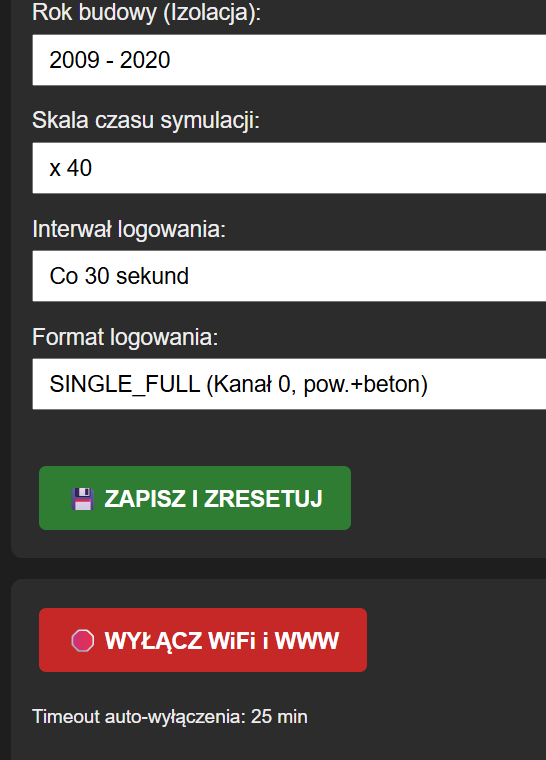
The idea to make a tester was born while working on Emilia2023. I was looking for a way to check the module. The crossing of two identical modules differing only in software seemed easy to implement. However, the question arose: how would the tester assess the results of the Emilia module? It is easier to say that it works. But how to assess the effect of this functioning? At that time, I did not have a sufficiently strong processor to be tempted to build a model of a real building with typically installed heating circuits. The idea of how it appeared disappeared. However, when I started thinking about the new generation of Emilia2026, when I focused on working with AI, making a tester became a necessary condition. There is no other sensible method of checking the operation of this type of modules. Testing in an existing building is totally pointless. There is no chance of carrying out all the necessary trial scenarios. People who have their own requirements live / are staying in the building / stay. The time of such 'testing' cannot be accelerated in any way. How to get an objective test result? Relying on the opinions of residents / users for the reasons described on the blog in the entry: Floor heating does not make any sense. For the same reason, it is impossible to train a reaction to the given conditions there. Years of study provided me with the ability to calculate the methods of heat transfer between individual centers. I know how it is done, I can calculate how long it will take place. And my AI team can translate it into good code when I explain what's going on. The new processor can handle the task without any problems .. It took a while for the idea to take shape. I spent many days trying to clothes the necessary knowledge in a story understandable to AI. The skeleton was created very efficiently. But then the idea started to get rich. Because for what reason to refuse to add the possibility of choosing the year of building a house and thus changing heat losses. Yes, it is not necessary for Emilia's training. She can handle various buildings by getting to know them during work. But how much knowledge can be conveyed when the charts show what is barely intuitive. I don't need anything in the data file. that the rush of info makes it difficult to understand what is happening .. but on the other hand, more data is needed in some scenarios. So we have added the ability to configure readings. Test week prevents data tracking on the computer screen. I work normally, and I have a lot of errands to do. The simulator has learned to remember the results and put it into the computer on demand. And finally it is. Of course, it was difficult not to make a few loops (starting after lowering the temperature, reaching the set point, reaching the highest temperature, going down again until the thermostat is turned on, another circle and the next ones to see the changes. Find out that the more we cool the object, the harder we overheat it in the first loop. Find out that the building is insulated worse when warming up more than well insulated. Find out how long it takes. It's hard to break away from this game. I collected the results to my computer, then I will translate it into charts and post it on the blog.